CNGE
The National College of Teaching General Practitioners (CNGE) is a key organization in the healthcare sector dedicated to training and education for general practitioners. Wanting to optimize access to validated medical information and improve the day-to-day efficiency of its members, CNGE launched an AI-based conversational assistant as part of the EBiM project.

Issues and objectives
Context
With EBiM, CNGE aimed to provide its member general practitioners with a reliable, secure, and high-performing generative AI tool to assist them in practice. The goal was to create a true medical conversational AI agent that synthesizes and presents clinically relevant information during consultations.
The chosen solution, Le Chat from Mistral AI, had to rely exclusively on data sources validated by experts to guarantee relevance and safety of the provided information — a critical requirement in healthcare.
Key objectives
The implementation project for this AI conversational agent targeted the following specific objectives:
- Provide a reliable AI: The tool must ensure precise and reliable medical answers, based exclusively on expert-validated data sources, leveraging a Large Language Model (LLM) such as Mistral AI.
- Support physicians in efficiency and quality of care: Facilitate rapid access to information to optimize decision-making and support high-quality clinical practice.
- Leverage CNGE resources: Capitalize on the organization’s knowledge by feeding the solution with CNGE document libraries and validated websites.
Solution and use case
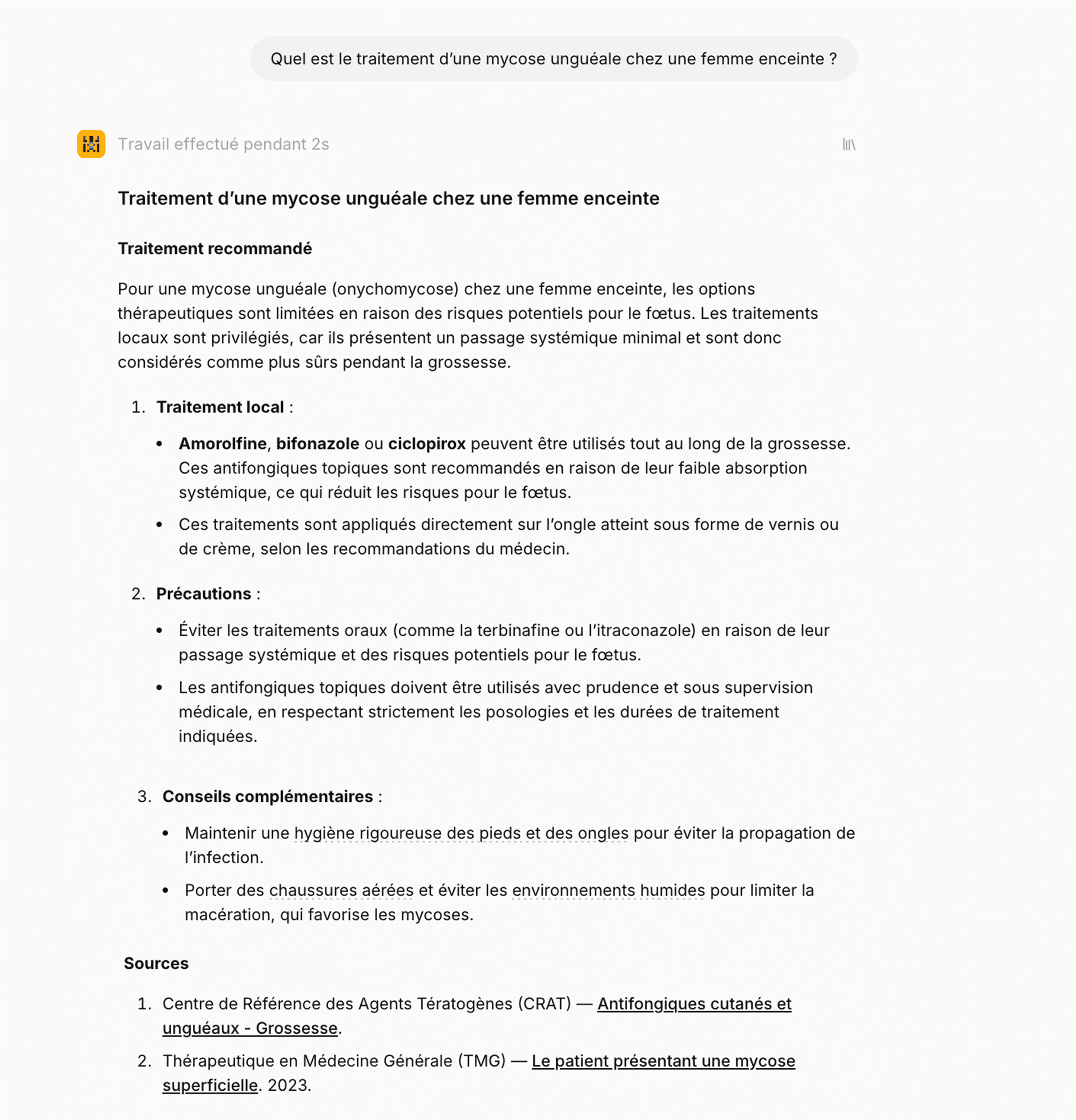
The project revolves around deploying the Le Chat environment and creating the Quick Search in Consultation Agent.
This agent is the project’s cornerstone, designed for direct use in front of a patient. Its effectiveness relies on the speed of Mistral AI technology and the relevance of CNGE-validated sources.
| Characteristic | Specification |
|---|---|
| Use context | Quick research during a consultation. |
| Response time | Less than 5 seconds |
| Expected answer | Precise and referenced, quickly providing essential information. |
| Information priorities | Diagnostic hypotheses, differential diagnoses, prevalent and severe diagnoses, therapeutics, dosages, contraindications and drug interactions. |
| Expertise level | Address the needs of a primary care clinician. |
| Data sources | Only validated and reliable sources; integration of document libraries and websites provided by CNGE. |
Technical stack and approach
The technical approach focuses on integrating validated data sources and configuring the conversational agent to guarantee reliable AI responses.
- Platform: Use Le Chat from Mistral AI to provide the conversational infrastructure.
- Data sources: Integrate CNGE documentary and web resources, with a strict validation requirement for all sources.
- Data scraping for the AI: To ingest CNGE document libraries and websites, custom ingestion scripts were developed. These scraping scripts convert heterogeneous formats (HTML, etc.) into a data structure optimized for the Mistral AI engine. This module ensures consistent ingestion and updates, forming the reliable knowledge base required by the conversational agent.
- Dynamic automation mechanism: A data pipeline system was developed to ensure continuous automated ingestion of validated sources provided by CNGE. These pipelines perform regular and secure scraping of all resources (validated websites). This automation mechanism ensures the knowledge base used by the agent remains aligned with the latest CNGE publications.
- Deployment: Configure the environment and create the “Quick Search in Consultation” agent, prioritizing execution speed and accuracy.
Results and benefits of the project
Implementing the medical conversational assistant for CNGE delivers tangible benefits for member general practitioners:
- Increased information reliability: The assistant ensures responses are based exclusively on CNGE-validated knowledge, reducing the risk of errors from unverified sources.
- Time savings in consultation: With a required response time of under 5 seconds for quick searches, the tool allows physicians to access critical information (such as dosages or interactions) without disrupting the consultation.
- Improved quality of care: By providing rapid, targeted access to expert knowledge (diagnostic hypotheses, therapeutics), the platform directly supports better clinical decision-making.
- Capitalization of CNGE knowledge: Integrating the organization’s documentary resources into the platform preserves and highlights the knowledge developed by the College for its members.
- Coverage of multiple needs: The strategy of three specialized agents ensures the tool is relevant and optimized for different aspects of general practice.